

Why Dogs React More on the Lead
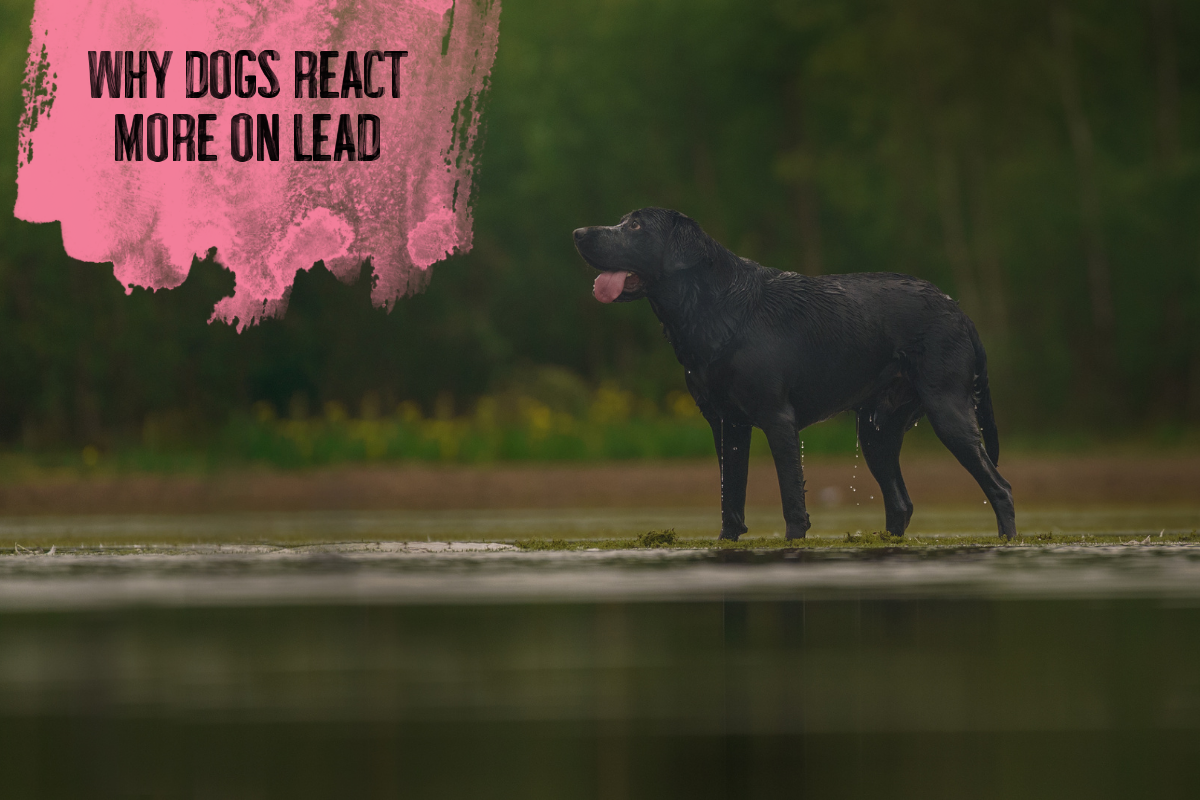
Many dogs react more on the lead because the lead removes choice. When a dog cannot move away, investigate freely, or create distance on their own, stress can build much faster. In behavioural science, perceived lack of control is a key factor in stress responses, and animals are more likely to show heightened reactivity when they cannot influence their environment (Dess et al., 1983).
Why the lead could change reactivity in dogs
A lead can turn a manageable trigger into a much bigger problem. Even if a dog is coping fairly well, the moment they feel physically restricted, their emotional response can change.
From the dog’s perspective, the environment becomes less predictable and less controllable. They may notice the same trigger they would normally tolerate, but without the ability to move freely, their sense of safety is reduced. Physiological studies in dogs show that restraint and exposure to stressors can increase cortisol levels, heart rate, and observable stress behaviours (Beerda et al., 1998).
The lead itself is not the problem. It is the change in perceived control, movement, and distance that alters how the dog experiences the situation.
The role of frustration
Some dogs are not reacting from fear first. They are reacting because they want to get to something and cannot, which creates frustration and rising arousal.
This is particularly common in dogs who are highly social, highly motivated to chase, or used to greeting freely. When the lead prevents access, the dog experiences a conflict between intention and restriction. Over time, this can condition a pattern where the sight of the trigger predicts frustration, and the reaction begins earlier and more intensely.
This process is often described as barrier frustration, where restriction increases behavioural intensity rather than reducing it (Sherman & Mills, 2008).
The role of fear
For fearful dogs, the lead changes the situation in a different way. Instead of blocking access, it blocks escape.
If a dog feels unsure or threatened, their natural strategy may be to create distance. When that option is limited, the dog may shift more quickly into defensive behaviour, such as barking or lunging, as a way to push the trigger away.
This aligns with well-established defensive behaviour patterns, where aggression is more likely when avoidance is not possible (Overall, 2013).
In these cases, lead reactivity is often best understood as a distance problem rather than a control problem.
Why it often escalates over time
Lead reactivity can become stronger through repetition. If barking or lunging causes the trigger to move away (even accidentally) the behaviour can be reinforced.
From the dog’s perspective, the sequence becomes predictable: see trigger → react → trigger disappears. This reinforces the behaviour through negative reinforcement, making it more likely to occur again (Bouton, 2007).
At the same time, repeated exposure without adequate recovery can increase overall stress levels, lowering the dog’s threshold and making reactions happen more quickly.
Why punishment can make it worse
If a dog is already overwhelmed, punishment may increase stress rather than reduce it. While it may interrupt the behaviour in the moment, it does not change the underlying emotional response.
Research into training methods shows that aversive approaches are associated with increased stress signals and potential worsening of behaviour, particularly in fear-based cases (Herron et al., 2009; Ziv, 2017).
In some cases, punishment can also suppress early warning signals, making later reactions appear more sudden or intense.
What helps on lead
The most effective starting point is usually distance. If your dog can notice a trigger without reacting, they are more likely to remain under threshold and able to learn.
Helpful changes include:
Using quieter routes and calmer times of day in the earlier stages.
Giving your dog more space from other dogs and people.
Choosing equipment that reduces pressure and improves comfort.
Practising calm check-ins and turnaways before the walk becomes difficult.
Building predictable patterns so your dog knows what to expect.
These strategies align with desensitisation and counterconditioning approaches, which aim to gradually change the dog’s emotional response rather than simply suppress behaviour (Overall, 2013).
Why predictability matters
Predictability reduces uncertainty, and uncertainty is a major driver of stress. When a dog begins to understand patterns—such as moving away from triggers rather than towards them—their confidence can increase.
Over time, consistent handling helps the dog form new associations, where triggers are no longer linked with frustration or fear, but with distance, safety, and reward.
Reactive Dog Photography
For reactive dogs, lead handling during a session can significantly affect behaviour. A tight lead, close proximity, or sudden restriction can increase stress quickly.
Using a long line, working at a distance, or choosing enclosed locations where the lead can be removed safely often leads to calmer, more natural behaviour.
The same principles apply: space, predictability, and low pressure create better outcomes for my client dogs.
FAQs
Why is my dog calm off lead but reactive on lead?
Off lead, your dog has more control over distance and movement. On lead, that control is reduced, which can increase fear or frustration.
Is a harness better than a collar?
A harness can improve comfort and reduce pressure for many dogs, particularly those who pull, but the best choice depends on the individual dog and fit.
Can leash reactivity improve?
Yes. With consistent management, appropriate distance, and training focused on emotional change, many dogs become significantly easier to walk over time.
References
Beerda, B., Schilder, M.B.H., van Hooff, J.A.R.A.M., de Vries, H.W. and Mol, J.A. (1998) ‘Behavioural, saliva cortisol and heart rate responses to different types of stimuli in dogs’, Applied Animal Behaviour Science, 58(3–4), pp. 365–381.
Bouton, M.E. (2007) Learning and Behavior: A Contemporary Synthesis. Sunderland, MA: Sinauer Associates.
Dess, N.K., Chapman, C.D. and Minor, T.R. (1983) ‘Inescapable shock increases finickiness about drinking quinine-adulterated water in rats’, Learning and Motivation, 14(2), pp. 223–239.
Herron, M.E., Shofer, F.S. and Reisner, I.R. (2009) ‘Survey of the use and outcome of confrontational and non-confrontational training methods in client-owned dogs showing undesired behaviors’, Applied Animal Behaviour Science, 117(1–2), pp. 47–54.
Overall, K.L. (2013) Manual of Clinical Behavioral Medicine for Dogs and Cats. St. Louis: Elsevier.
Sherman, B.L. and Mills, D.S. (2008) ‘Canine anxieties and phobias: an update on separation anxiety and noise aversions’, Veterinary Clinics of North America: Small Animal Practice, 38(5), pp. 1081–1106.
Ziv, G. (2017) ‘The effects of using aversive training methods in dogs—A review’, Journal of Veterinary Behavior, 19, pp. 50–60.