

REACTIVITY: Early Stress Signals Owners Miss
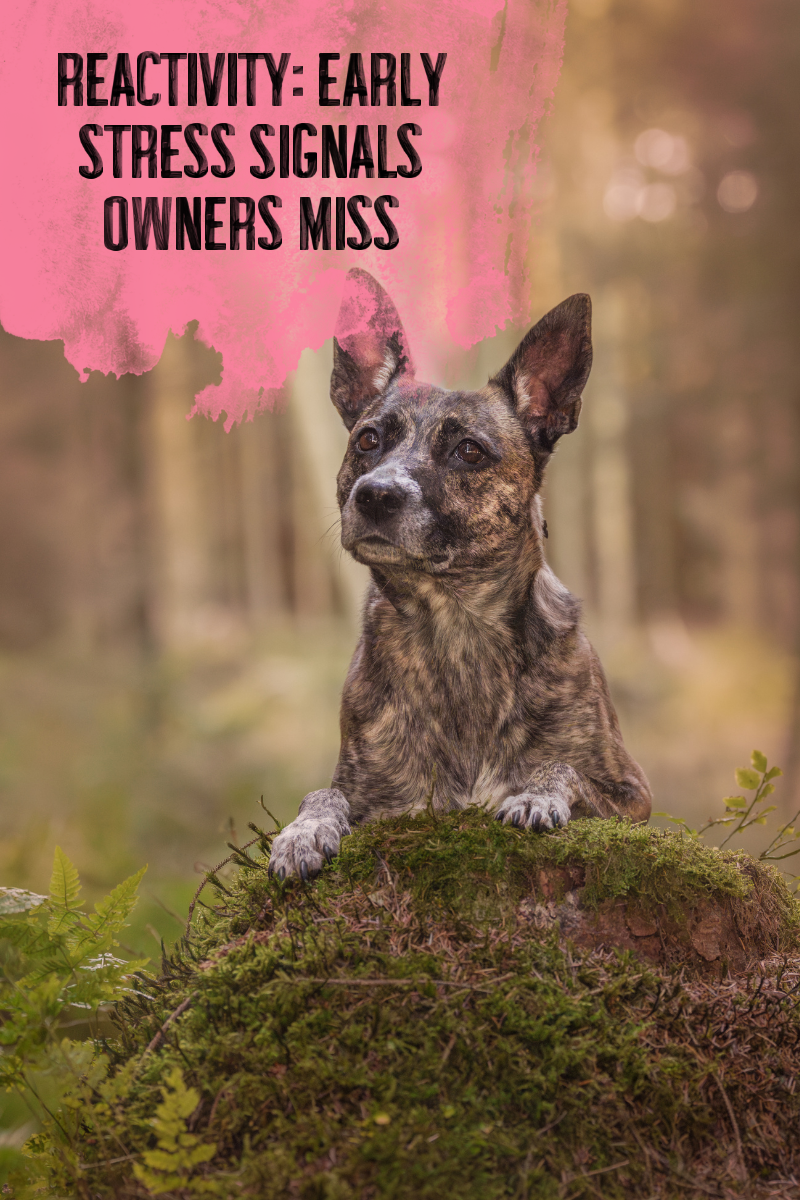
The biggest reactions usually do not start with barking. They start with much smaller body-language signals that many owners miss the first few times. These early signals are part of a graded stress response, where behaviour escalates only if the dog’s initial attempts to cope or communicate are unsuccessful (Beerda et al., 1998).
The signs to watch for
Early stress signals can include lip licking, yawning, blinking, sniffing the ground, turning away, freezing, a hard stare, a closed mouth, or a sudden change in posture. These behaviours are commonly described as displacement or calming signals, reflecting internal conflict or an attempt to de-escalate a situation (Rugaas, 2006).
In many cases, these signals appear seconds—or even minutes—before a more obvious reaction. For example, a dog may briefly pause, close their mouth, and fix their gaze before barking. These small changes are often the earliest visible indicators of rising arousal.
Why these signals matter
If you wait until barking or lunging starts, your dog may already be well over threshold. Once that happens, your dog’s ability to process information and learn is significantly reduced due to the effects of stress hormones such as cortisol and adrenaline, and the brains reliance on the amygdala for quick decision making under threat (Joëls et al., 2006).
This is why early intervention is so powerful. Responding at the level of subtle stress allows you to keep the dog within a manageable emotional range, where learning and recovery are still possible.
There is also a cumulative effect to consider. Repeated exposure to stress without adequate recovery—sometimes referred to as “trigger stacking”—can lower a dog’s threshold over time, making reactions more likely and more intense (McEwen, 2007).
What a stressed dog may look like
Some dogs become still and quiet rather than noisy. They may stop sniffing, stiffen their body, or fixate on the trigger with intense focus before the outward reaction appears. This “freeze” response is a well-recognised part of the defensive behaviour sequence.
Others may become suddenly bouncy, mouthy, or unable to settle. Increased activity can also be a sign of rising stress, and a difficulty to cope.
Not all stress looks the same, which is why context, pattern recognition, and familiarity with your individual dog are so important.
How owners can respond
If you see the early signs, create more distance, lower the pressure, and give your dog space to recover. That simple intervention can prevent escalation and reduce the overall stress load of the walk.
It also helps to track patterns. You may notice that your dog reacts faster in certain environments, at certain times of day, or when already tired or overstimulated. These patterns are often more predictive than any single trigger.
Over time, responding early helps change the dog’s expectations. Instead of rehearsing reactive behaviour, the dog begins to experience situations where stress is noticed and reduced before it becomes overwhelming.
REACTiVE DoG PHOTOGRAPHY
A photographer working with anxious or reactive dogs should be fluent in these early signals. That allows the session to stay calm, flexible, and dog-led rather than pushing past the dog’s comfort zone.
That calm observational skill is often more important than the camera settings. When the dog feels safe and understood, their behaviour becomes more natural, which leads to better images.
FAQs
Is yawning always stress?
No. Yawning can occur for different reasons, but in the right context it can be a useful indicator of rising stress or uncertainty.
Why does my dog freeze before reacting?
Freezing can be part of the defensive sequence, indicating tension or conflict before escalation.
Should I intervene at the first sign?
Usually yes. Early intervention is often easier, more effective, and kinder than waiting for a full reaction.
References
Beerda, B. et al. (1998) Applied Animal Behaviour Science, 58, pp. 365–381.
Joëls, M. et al. (2006) Trends in Cognitive Sciences, 10, pp. 152–158.
McEwen, B.S. (2007) Physiological Reviews, 87, pp. 873–904.
Rugaas, T. (2006) On Talking Terms with Dogs.