

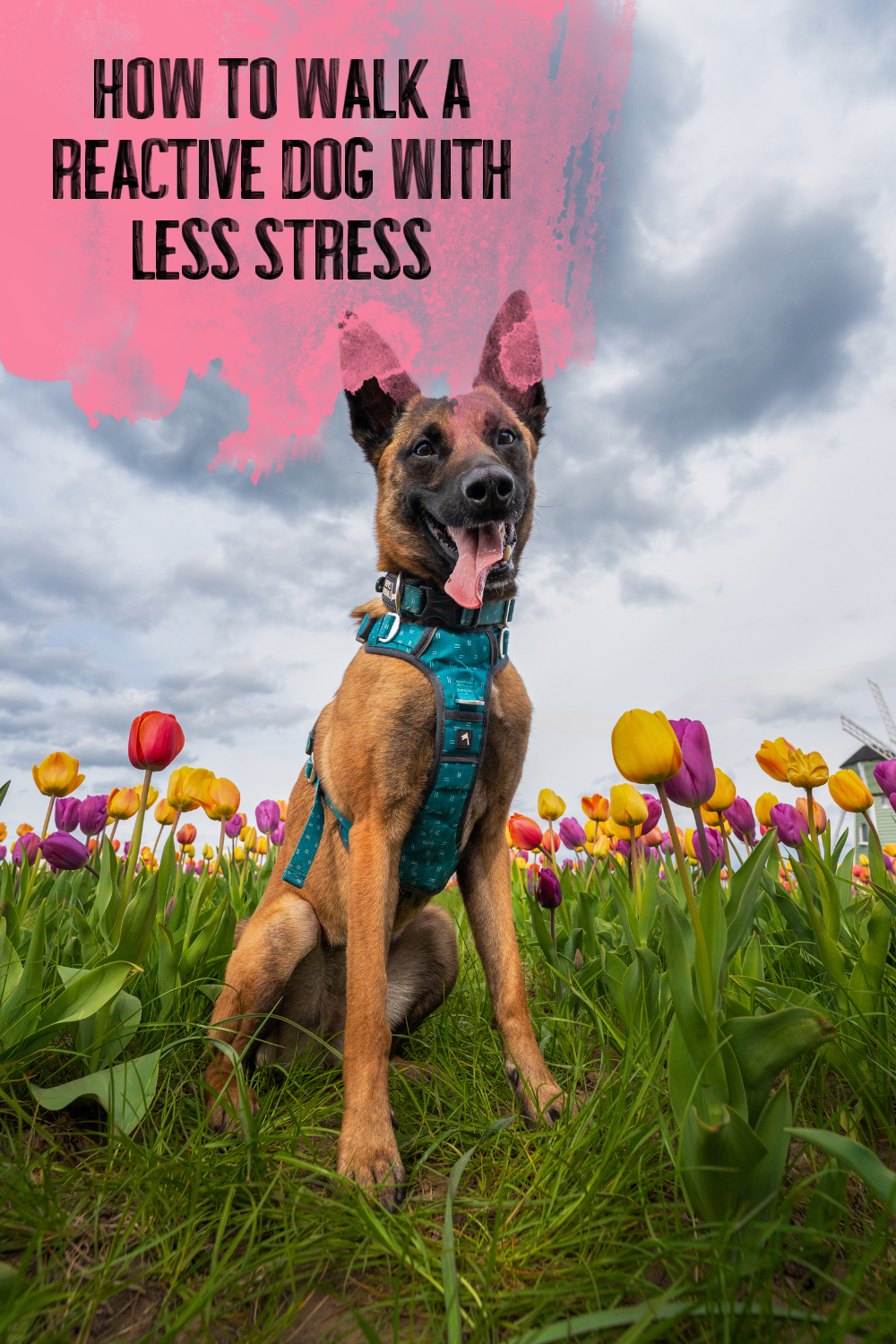
How to Walk a Reactive Dog With LESS Stress
Walking a reactive dog is one of the most emotionally complex parts of living with a sensitive animal. What should be a simple daily routine often becomes a careful negotiation with the environment: scanning ahead, listening for distant barks, watching for cyclists, children, dogs off lead, or anything else that might push your dog over threshold.
For many owners, the walk becomes less about enjoyment and more about survival. And yet, despite how heavy it can feel, the walk is also one of the most meaningful opportunities to support your dog’s emotional wellbeing — when it’s approached with understanding, compassion, and science.
Reactivity is not a training failure. Reactivity is a stress‑based behavioural response, shaped by physiology, environment, and past experiences. Understanding what’s happening inside your dog’s body and brain is the first step toward creating calmer, safer walks.
Why Walks Are So Challenging for Reactive Dogs
Reactivity is closely tied to the dog’s stress response system, particularly cortisol — the hormone that helps the body respond to perceived threats. Dogs who struggle with reactivity often show higher or more prolonged cortisol responses when faced with stressors, and dogs with slower cortisol recovery tend to display more undesirable behaviours in daily life, including heightened reactivity (Lensen et al., 2019).
This means that when your dog reacts on a walk, it is not always a conscious choice. It is a physiological cascade: their nervous system detects a threat, their stress hormones rise, and their behaviour follows.
Dogs also differ in their coping styles. These coping styles influence how dogs respond to environmental triggers and how quickly they recover afterwards (Mârza et al., 2024).
For a reactive dog, a walk is not simply a walk. It is a landscape of unpredictable sensory input, each sound or movement carrying the potential to activate their stress system. This can also explain reactivity to specific elements of a known route, over time a conditioning effect of increased phsyiological response paired with that location or element can result in increased reactivity in that location.
The Environment Matters More Than Most People Realise
A reactive dog’s behaviour is deeply influenced by the environment they walk in. Busy streets, narrow pavements, barking dogs behind fences, children playing, traffic noise, and sudden movement all contribute to sensory load. When stress accumulates faster than the dog can process it, their threshold lowers — and reactivity becomes more likely.
Environmental stressors have been shown to influence cortisol levels and behavioural responses in dogs (Mârza et al., 2024). This means that choosing quieter routes, walking at calmer times of day, and giving your dog more space are not “avoidance behaviours.” They are evidence‑based welfare decisions that support emotional regulation, and can be an effective part of a management and training plan.
A dog who feels safe learns. A dog who feels unsafe reacts.
The Role of Equipment in Emotional Safety
While equipment cannot change a dog’s underlying emotional state, it can dramatically influence how safe and supported they feel. A well‑fitted Y‑front harness protects the neck and allows natural movement, reducing physical discomfort that can exacerbate stress. A longer lead (2–3 metres) gives the dog space to move, sniff, and create distance — all behaviours associated with lower arousal and improved emotional regulation.
When the handler feels more in control, their own stress decreases, dogs are highly sensitive to human emotional states and can track both human body language and gaze. Calm handling can support calmer behaviour.
Understanding Triggers Before They Become Reactions
Reactive dogs rarely “explode out of nowhere.” Before a full reaction, there are almost always subtle signs:
Pausing
Shifts in ear position
Tightening of the body
Freezing
Raising Hackles (piloerection)
Staring
These early signals reflect the dog’s initial stress reactivity, which is measurable through physiological markers such as cortisol and heart rate (Gobbo & Zupan Šemrov, 2021). When owners learn to recognise these early signs, they can intervene before the dog reaches their threshold — protecting the dog’s emotional wellbeing and preventing the escalation that leads to barking, lunging, or freezing.
Distance Is Not Avoidance
One of the most powerful tools for supporting a reactive dog is distance. Distance allows the dog to observe a trigger without feeling trapped or overwhelmed. At a safe distance, the dog’s stress response remains manageable, and their brain stays open to learning. When distance is removed — for example, on narrow pavements or when a dog appears suddenly around a corner — the dog’s stress system activates rapidly, and reactivity becomes far more likely.
Distance is not about avoiding the world. It is about giving your dog the space they need to process and to learn, and can be a useful metric to track progress, and ‘temperature test’ how your dog is feeling.
Why Sudden Triggers Feel So Big
Even with careful planning, surprises happen: a dog appears from behind a hedge, a child runs past, a car door slams.
Sudden triggers activate the dog’s acute stress response, which can cause rapid neuroendocrine and cardiovascular changes (Gobbo & Zupan Šemrov, 2021). This is why your dog may react intensely to something unexpected, even if they were coping well moments before. Their body is responding faster than their conscious mind can process. Having a rehearsed plan — moving behind a parked car, creating distance, using a pattern game, or scattering treats — helps both you and your dog recover more quickly.
One of the most overlooked aspects of reactive‑dog life is the emotional burden on the owner. Many describe feeling embarrassed, judged, or isolated. Some avoid walks altogether because the fear of “what if” becomes overwhelming.
Reactivity is not a reflection of your ability as an owner. It is a reflection of your dog’s stress system, their history, and their coping style. You are not failing. You are supporting a dog who experiences the world more intensely than others — and that is something to be proud of.
Reactive‑dog progress is rarely linear. Some days feel effortless; others feel impossible. But progress is not solely defined by the absence of reactions. It is can defined by:
Faster recovery
Calmer observation
Increased check‑ins
More curiosity
Less scanning
More moments of connection
These are signs of improved emotional regulation — and they matter far more than a “perfect walk.”
References
Gobbo, E., & Zupan Šemrov, M. (2021). Neuroendocrine and Cardiovascular Activation During Aggressive Reactivity in Dogs. Frontiers in Veterinary Science, 8.
Lensen, R.C.M.M., Moons, C.P.H., & Diederich, C. (2019). Physiological stress reactivity and recovery related to behavioral traits in dogs (Canis familiaris). PLoS ONE, 14(9).
Mârza, S.M., et al. (2024). Behavioral, Physiological, and Pathological Approaches of Cortisol in Dogs. Animals, 14(23).