

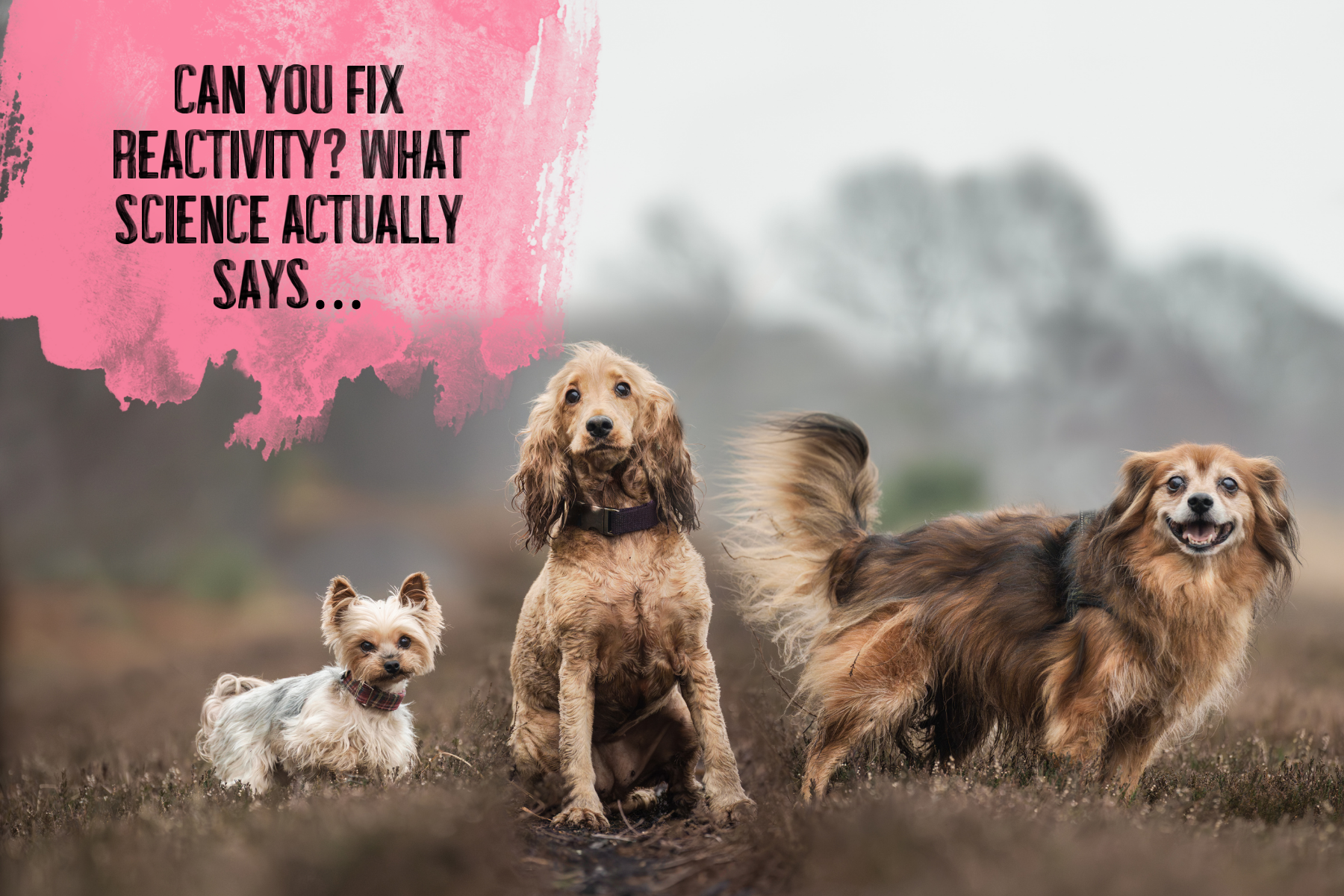
Can You Fix Reactivity? What Science Actually Says…
Few questions weigh more heavily on reactive‑dog guardians than this one: “Can I fix it?”
It’s a question rooted in hope, fear, responsibility, and love. It’s also a question shaped by the pressure of modern dog culture — a culture that often promises quick fixes, perfect obedience, and total control.
But reactivity is not a broken part to be repaired. It is a stress‑based behavioural pattern, shaped by genetics, early experiences, environment, neurobiology, and learning history. And because of that, the idea of “fixing” reactivity oversimplifies something far more complex — and far more hopeful.
Science doesn’t support the idea of a single cure. But it does support the possibility of meaningful, life‑changing improvement.
Reactivity Is Not a Choice — It’s a Stress Response
Reactivity is often misunderstood as disobedience or stubbornness. In reality, it is a neurobiological response driven by the dog’s fear circuits, stress hormones, and coping style.
Research shows that dogs vary widely in their stress reactivity and recovery, and that dogs with slower cortisol recovery tend to show more intense or persistent reactive behaviours (Lensen et al., 2019).
This means:
Some dogs recover quickly after stress
Some recover slowly
Some remain on high alert for longer
Some are genetically predisposed to heightened sensitivity
Reactivity is not a behavioural choice. It is a physiological state.
Why “Fixing” Reactivity Isn’t the Right Question
The idea of “fixing” implies a binary: broken vs. cured. Behaviour science doesn’t work in binaries.
Reactivity is influenced by:
Genetics
Early socialisation
Trauma or negative experiences
Pain or medical issues
Environment
Learning history
Stress load
Coping style
These factors interact in complex ways. Research on canine fear and aggression shows that behaviour is multifactorial, meaning no single intervention can eliminate it entirely (Overall, 2013).
So the real question isn’t: “Can I fix reactivity?” but rather: “Can my dog improve, cope better, and feel safer?”
And the answer to that is almost always yes.
What Science Says About Behaviour Change
Behaviour change in dogs is grounded in two core principles:
1. Learning changes behaviour
Counterconditioning, desensitisation, and reinforcement‑based training reshape emotional responses and coping strategies (Bouton, 2016).
2. Stress biology shapes what a dog can learn
A dog cannot learn new emotional responses when over threshold. Stress inhibits cognitive processing and increases reactive behaviour (Beerda et al., 1998).
This is why reactive‑dog training is not about obedience — it’s about emotional safety and regulation.
Why Some Dogs Improve Dramatically — and Others Improve Slowly
Dogs differ in their coping styles and personality. Some dogs are proactive (bold, assertive), while others are reactive copers (sensitive, cautious). These styles influence how dogs respond to stress and how quickly they recover (Mills et al., 2014).
Other factors include:
Genetics — certain breeds or lines are more vigilant or have reactivity-related instinctive drives.
Early experiences — trauma or lack of or inappropriate socialisation increases risk
Pain — a major contributor to reactivity (Mills et al., 2020)
Environment — stressful or chaotic environments can increase stress load.
Guardian support — consistency and emotional consideration.
Improvement is possible for almost all dogs — but the degree and speed of improvement vary.
Why Management Is Not “Giving Up”
Management — choosing quiet routes, creating distance, avoiding known triggers — is sometimes dismissed as “avoiding the problem.” But research shows that reducing exposure to overwhelming stimuli is essential for behaviour change (Hennessy et al., 1997).
When a dog repeatedly encounters triggers they cannot cope with:
Stress accumulates
Reactivity intensifies
Learning shuts down
Fear becomes more deeply conditioned
Management protects the dog’s nervous system so learning can occur, this means you can choose when to increase duration. intensity or proximity of triggers as part of your training while still supporting your dog.
What Improvement Actually Looks Like
Improvement rarely looks like a dog who never reacts again. Instead, it looks like:
Faster recovery
Softer body language
More curiosity
Fewer intense reactions
More check‑ins
Better ability to disengage
Reduced scanning
Increased trust
Neutrality around triggers
These are signs of emotional regulation, not obedience.
And they matter far more than perfection.
So… Can You Fix Reactivity?
You can change emotional responses
You can reduce reactivity dramatically
You can improve coping skills
You can build resilience
You can create safety
You can transform your dog’s quality of life
But “fixing” — in the sense of erasing reactivity entirely — is not a realistic or scientifically supported goal. Reactivity is not a flaw. It is a stress response, and stress responses can be reshaped, softened, and supported. Your dog does not need to be “fixed.” Your dog needs to feel safe.

References
Beerda, B., et al. (1998). Behavioural, saliva cortisol and heart rate responses to different types of stimuli in dogs. Applied Animal Behaviour Science.
Bouton, M.E. (2016). Learning and Behavior: A Contemporary Synthesis.
Hennessy, M.B., et al. (1997). Effects of predictable vs. unpredictable stressors on behaviour and physiology. Physiology & Behavior.
Lensen, R.C.M.M., Moons, C.P.H., & Diederich, C. (2019). Physiological stress reactivity and recovery related to behavioral traits in dogs. PLoS ONE.
Mills, D.S., et al. (2014). Stress and behavioural disorders in dogs. Journal of Veterinary Behavior.
Mills, D.S., et al. (2020). Pain and problem behaviour in cats and dogs. Journal of Veterinary Behavior.
Overall, K. (2013). Manual of Clinical Behavioral Medicine for Dogs and Cats.