

When Your Dog’s Anxiety Becomes Your Anxiety
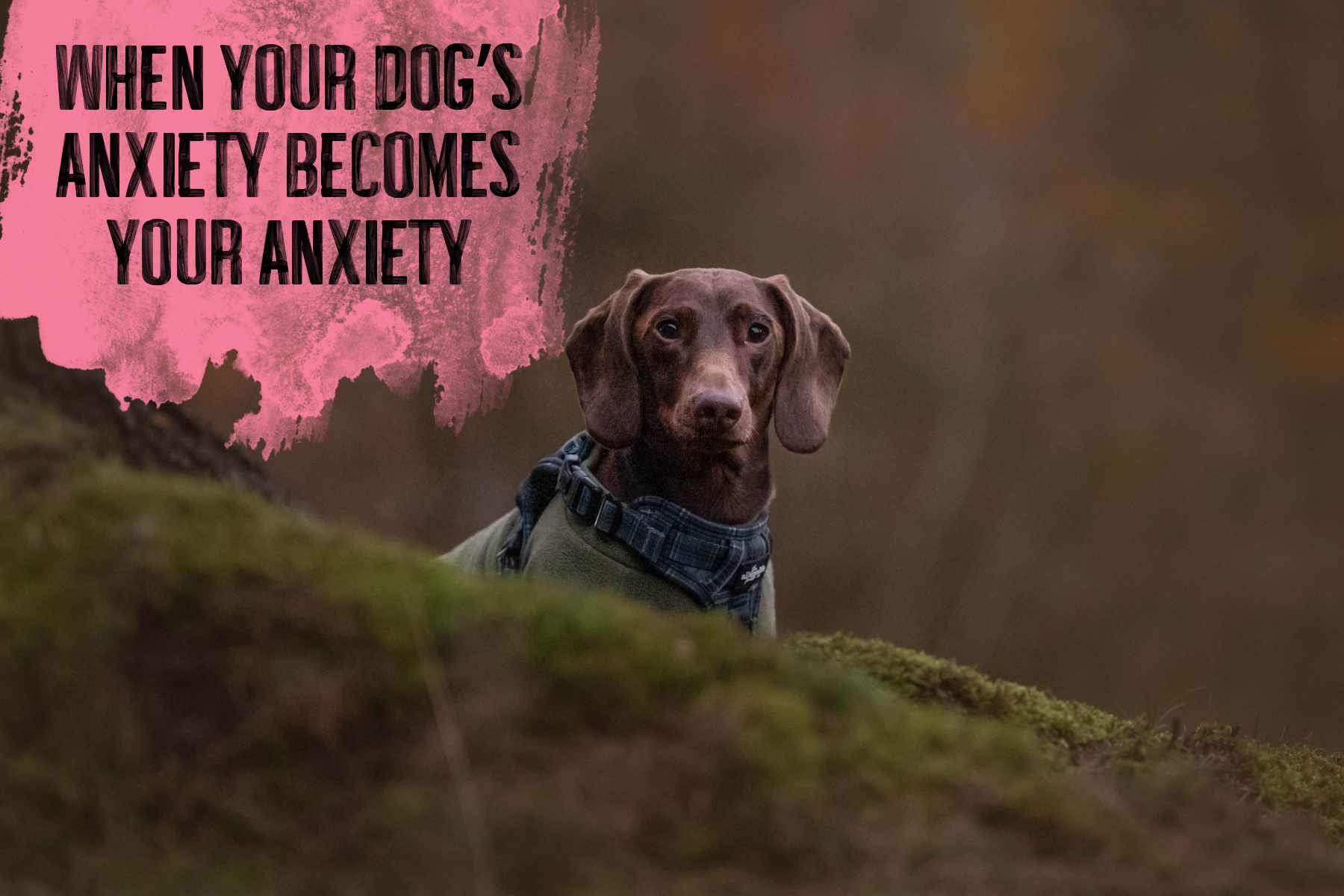
Living with an anxious dog changes you. It shifts your routines, your priorities, your emotional landscape. You begin to anticipate triggers before they happen. You scan the environment the way your dog does. You plan walks around quiet times, avoid busy places, and brace yourself for the unexpected.
Over time, your dog’s anxiety can become your anxiety.
This experience is not a sign of weakness or over‑attachment. It is a natural consequence of the human–animal bond — a bond so deep that our nervous systems begin to influence one another. Dogs detect human emotional states through scent and behaviour (D’Aniello et al., 2018), and humans, in turn, show physiological changes in response to their dog’s stress (Handlin et al., 2011). Anxious dogs do not suffer alone. Their guardians feel it too.
The Emotional Weight of Caring for an Anxious or Reactive Dog
Caring for an anxious dog is an act of love and an act of endurance. Guardians often describe feeling:
Tense before walks
Worried about unexpected triggers
Guilty when the dog struggles
Hypervigilant in new environments
Exhausted by constant planning
Ashamed when others judge their dog’s behaviour
These experiences are not imagined. They are documented in research on caregiver burden, a term used to describe the emotional, physical, and social strain experienced by individuals caring for dependents with behavioural or medical challenges (Christiansen et al., 2016). Caregiver burden in dog guardians is real, and measurable.
Guardians of anxious or reactive dogs report higher levels of stress, social isolation, and emotional fatigue (Salonen et al., 2020). Many describe feeling “on edge,” mirroring the very behaviours their dogs display. Your dog’s anxiety becomes your anxiety because you care — and because you are human.
Why Your Dog’s Anxiety Affects You So Deeply
The emotional impact of a dog’s anxiety is shaped by several interconnected factors: neurobiology, attachment, social pressure, and lived experience.
Humans and dogs co‑regulate — meaning each partner’s emotional state influences the other’s. When your dog becomes anxious, your body responds. Heart rate increases, muscles tense, breathing changes. This is not imagination; it is physiology. Dogs can detect human stress through chemosignals (D’Aniello et al., 2018), and humans show hormonal changes when interacting with stressed dogs (Handlin et al., 2011).
Guardians of anxious dogs often develop anticipatory anxiety — a state in which they worry about potential triggers before they occur. This mirrors the dog’s own hypervigilance and is reinforced through repeated stressful experiences. Anticipatory anxiety is a well‑documented phenomenon in human psychology (Grupe & Nitschke, 2013), and emerges when caring for a dependent who struggles with unpredictability.
Many guardians describe feeling embarrassed or judged when their dog reacts. Social pressure amplifies stress, especially when others misunderstand anxiety‑based behaviour as “bad training” or “poor control.” Guardians of behaviourally challenged dogs often withdraw from social activities due to fear of judgement (Christiansen et al., 2016).
The human–dog bond is profound. Attachment research shows that dogs form relationships with guardians similar to infant–caregiver bonds (Topál et al., 1998). When your dog suffers, your attachment system activates, creating emotional resonance.

How Anxiety Shows Up in Guardians
Just as trauma, noise sensitivity, or general anxiety show up in dogs through behavioural patterns, your dog’s anxiety shows up in you.
You may notice:
Tension before leaving the house
Avoidance of certain environments
Difficulty relaxing during walks
Hypervigilance around other dogs or people
Guilt after difficult outings
Exhaustion from constant planning
Worry about the future
Feeling “trapped” by routines
Emotional fatigue after stressful days
These experiences mirror the dog’s own emotional patterns, and your nervous system is doing what nervous systems do: responding to the emotional signals around it.
The Hidden Grief of Living With an Anxious Dog
Many guardians experience a quiet grief — a grief for the life they imagined with their dog. The easy walks. The café visits. The social outings. The freedom. This grief is rarely spoken aloud, yet it is deeply felt. It is the grief of adjustment, of acceptance, of loving a dog whose world is smaller and harder than you hoped. Grief does not mean you love your dog less.
Supporting an anxious dog requires emotional resilience — and resilience requires care. Not just for the dog, but for you.
Just as dogs benefit from predictable, calm environments, guardians benefit from reducing sensory overload. Quiet routines, slower transitions, and intentional rest help regulate your nervous system. Predictability reduces stress in humans as well as dogs (Hennessy et al., 1997). Consistent walk times, structured decompression, and stable routines help both nervous systems settle.
Talking to others who understand — trainers, behaviourists, guardians of anxious dogs — reduces isolation and normalises your experience. Social buffering is a well‑documented protective factor in stress research (Hostinar et al., 2014). Caregiver burden decreases when guardians take intentional breaks (Christiansen et al., 2016).
Progress in anxious dogs can be subtle — softer body language, quicker recovery, more curiosity. Noticing these changes supports your own emotional resilience. When your dog’s anxiety becomes your anxiety, it can feel overwhelming, this experience is not a sign of failure. Your dog is lucky to have you and you deserve support too.
References
Beerda, B., et al. (1998). Behavioural, saliva cortisol and heart rate responses to different types of stimuli in dogs. Applied Animal Behaviour Science.
Bouton, M.E. (2016). Learning and Behavior: A Contemporary Synthesis.
Christiansen, S.B., et al. (2016). The burden of caring for animals with behavioural problems. Veterinary Record.
Coppola, C.L., et al. (2006). Noise exposure and welfare in kenneled dogs. Journal of Applied Animal Welfare Science.
D’Aniello, B., et al. (2018). Interspecies transmission of emotional information via chemosignals. Animal Cognition.
Grupe, D.W., & Nitschke, J.B. (2013). Anticipatory anxiety: mechanisms and treatment. Nature Reviews Neuroscience.
Handlin, L., et al. (2011). Human–dog interaction and oxytocin release. Psychoneuroendocrinology.
Hennessy, M.B., et al. (1997). Effects of predictable vs. unpredictable stressors on behaviour and physiology. Physiology & Behavior.
Hennessy, M.B., et al. (2020). Stress, fear, and anxiety in dogs: neurobiology and behaviour. Journal of Veterinary Behavior.
Hostinar, C.E., et al. (2014). Social buffering of stress. Psychological Science.
Koch, M. (1999). The neurobiology of startle. Progress in Neurobiology.
Kostarczyk, E., & Fonberg, E. (1982). Effects of chronic stress on sleep in dogs. Physiology & Behavior.
LeDoux, J. (2012). Rethinking the emotional brain. Neuron.
McGowan, R.T.S., et al. (2014). Cognitive testing and welfare: effects of cognitive challenge on dogs. Applied Animal Behaviour Science.
Mills, D.S., et al. (2020). Pain and problem behaviour in cats and dogs. Journal of Veterinary Behavior.
Overall, K. (2013). Manual of Clinical Behavioral Medicine for Dogs and Cats.
Salonen, M., et al. (2020). Dog behaviour problems and owner stress. Scientific Reports.
Topál, J., et al. (1998). Attachment behaviour in dogs. Journal of Comparative Psychology.
Ziv, G. (2017). The effects of using aversive training methods in dogs. Journal of Veterinary Behavior.