

The Reactive Dog Rollercoaster: Why Progress Isn’t Linear
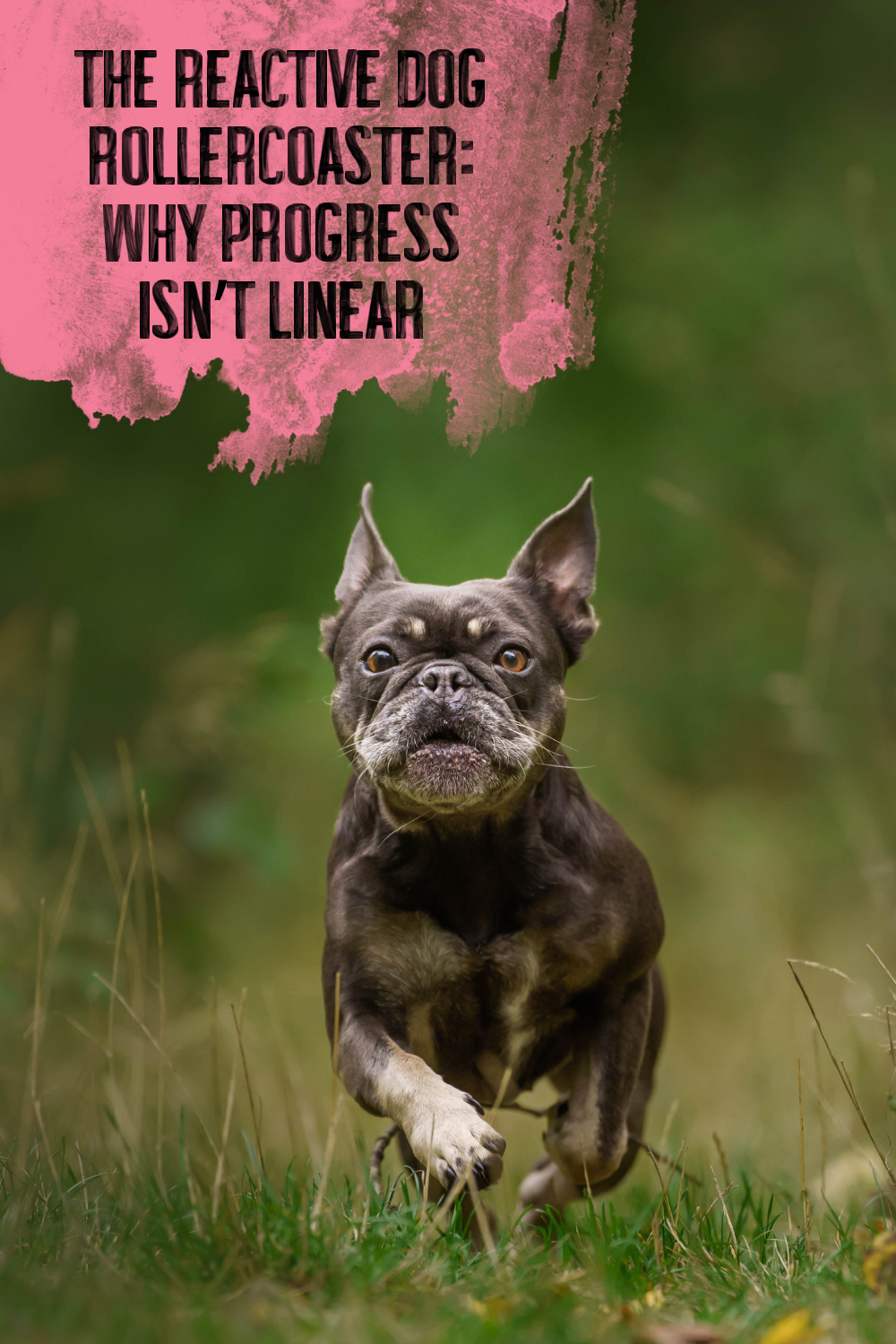
If you live with a reactive dog, you already know the truth that many training books gloss over: progress is not a straight line. It’s a rollercoaster — a series of hopeful climbs, sudden drops, unexpected twists, and moments where you feel like you’re finally levelling out… only to plunge again without warning.
This emotional turbulence isn’t a sign that you’re doing something wrong. It’s a sign that you’re doing something real.
Reactive‑dog guardians often carry this journey quietly, believing they’re alone in the chaos. But the ups and downs you’re experiencing are not only normal — they are predictable, explainable, and deeply human.
Below is a visual reference capturing the emotional rhythm reactive‑dog guardians often describe:
Why Progress Feels Like a Rollercoaster
Progress with reactive dogs is shaped by biology, environment, learning history, and emotional state — not by willpower or effort alone. Understanding these forces helps you see the rollercoaster for what it is: a natural part of behaviour change.
1. Stress Recovery Isn’t Linear
Dogs vary widely in how quickly they recover from stress. Dogs with slower cortisol recovery display more intense or persistent reactive behaviours (Lensen et al., 2019). Your dog’s nervous system is not a machine. It’s a living, fluctuating system responding to the world in real time.
This means:
Some days your dog’s stress bucket is emptier
Some days it’s already half‑full before you even leave the house
Some days a single trigger tips them over
Some days they cope beautifully
2. Environment Changes Everything
A quiet Tuesday morning walk is not the same as a sunny Saturday afternoon. Environmental density — noise, movement, proximity, unpredictability — dramatically affects reactivity (Sherman & Mills, 2008). So when your dog struggles on a day that “should have been fine,” it’s not regression. It’s context.
Reactive dogs may be sensitive to:
Weather
Time of day
Scent load
Traffic
Other dogs
Human activity
Sudden noises
3. Learning Isn’t Linear — In Dogs or Humans
Behaviour change follows a pattern known in psychology as the learning curve, which includes:
Initial improvement
Plateau
Regression
Consolidation
Breakthrough
This pattern has been documented across species, including dogs (Bouton, 2016).
4. Emotional Memory Is Powerful
Fear memories are stored differently from neutral memories. They are:
Stronger
Stickier
More easily reactivated
Fear conditioning can resurface even after successful behaviour modification (LeDoux, 2012). This is why a dog who has been doing well for weeks may suddenly react intensely to a familiar trigger. It’s not a setback — it’s the brain doing what it evolved to do: protect.
5. Your Emotions Influence Theirs
Reactive‑dog guardians often carry stress, anticipation, or dread on walks. Dogs can detect changes in human emotional states through scent and behaviour (D’Aniello et al., 2018). This doesn’t mean you’re causing the reactivity. It means you and your dog are connected. On days when you’re tired, stressed, or overwhelmed, your dog may struggle more, because you might be struggling more.
6. Caregiver Burden Is Real
Caring for an animal with behavioural challenges creates what researchers call caregiver burden — the emotional, physical, and social strain experienced by those supporting a dependent individual (Christiansen et al., 2016).Some days you feel strong. Some days you feel defeated. Both are normal.
This burden affects:
Motivation
Patience
Emotional resilience
Perception of progress

Why Setbacks Don’t Mean Failure
Setbacks feel devastating because they challenge the story we tell ourselves: “If I’m doing everything right, things should only get better.”
Setbacks are:
Expected
Temporary
Informative
Part of the process
A setback doesn’t erase progress. It reveals where support is still needed.
You Are Not Alone on This Rollercoaster
Reactive‑dog guardians often feel isolated, misunderstood, or judged. You are part of a community — a quiet, resilient, compassionate community of people who show up for their dogs every single day. You are not failing because the journey is hard. You are succeeding because you keep going. Your dog doesn’t need perfection. Your dog needs you — the person who reads, learns, adapts, advocates, and loves them through every twist and turn.

References
Bouton, M.E. (2016). Learning and Behavior: A Contemporary Synthesis.
Christiansen, S.B., et al. (2016). The burden of caring for animals with behavioural problems. Veterinary Record.
D’Aniello, B., et al. (2018). Interspecies transmission of emotional information via chemosignals. Animal Cognition.
LeDoux, J. (2012). Rethinking the emotional brain. Neuron.
Lensen, R.C.M.M., et al. (2019). Physiological stress reactivity and recovery related to behavioral traits in dogs. PLoS ONE.
Sherman, B.L., & Mills, D.S. (2008). Canine anxieties and phobias. Veterinary Clinics of North America.